


How to choose the best leather

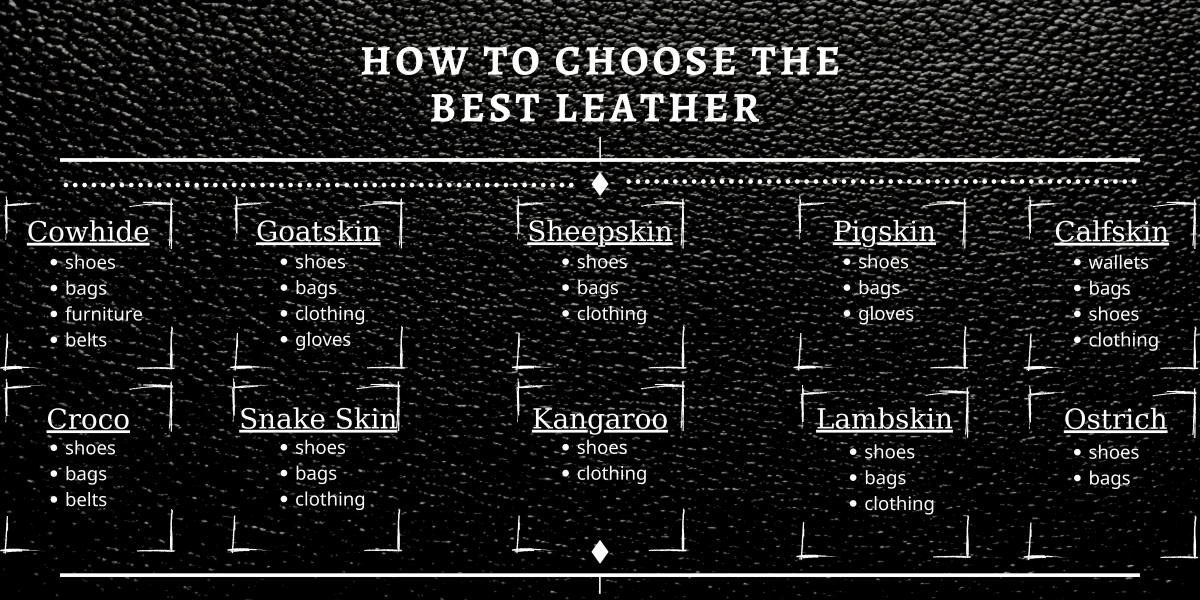
How do you pick The right leather for the job?
When you have to choose the best leather for a project, you have to ask, the right question you must ask yourself right away is: for what type of use or destination do I want this? To select the right leather hide, first identify the use that will be made of it.
The factors influencing the choice are mainly:
- Type of tanning
- Animal kind and breed
- Size of the skin
- Thickness of leather
- Finishing of the surface
So the fundamental question is: “What do I want to create with leather?”. You can always ask Leathermio for suggestions.
What type of leather is the best?
Basically, there is no best type of leather in absolute terms. Instead, there is the right type of leather for the project that you want to achieve. The type of leather or hide that you have to choose is influenced by the object and the final look.
The catalog of Leather Mio is already a full guide to buying leather. It already provides a detailed description of many types of leather that cover almost all uses. Each item is accompanied by photos and accurate descriptions of the characteristics of size, thickness, types of tanning, and finishing. Further clarifications can be requested directly by e-mail and also by telephone. To further narrow the field of choice in such a wide and varied world, we can send samples on request.
How to choose leather for furniture and upholstery
The leathers for furniture and upholstery are produced on cattle and are the largest ones with low thickness and soft temper. Characterized by a uniform and resistant finish, suitable for upholstery projects such as sofas, cars interiors, furniture, and so on.
How to choose leather for leather goods and bags
The leathers for leather goods and bags are of high quality, usually bovine hides or sheep. More suitable for making bags, totes, suitcases, wallets, bindings, covers, accessory cases, and clutches. They have thicknesses ranging from 1 mm up to 2.5 mm (2-6 oz.). The most common are half calves, shoulders, whole calves, lambskins, and bellies.
How to choose leather for shoes and footwear
The leathers for shoes and footwear are usually made of calfskin. You can also use sheep characterized by a more varied quality. Slightly lower than those for leather goods but with greater resistance to wear, bending, and atmospheric agents. The leather for footwear can be of two types:
- Full-grain leather, these are the finest leathers that maintain the character of the grain, they can be opaque, shiny, or printed;
- Split leather, obtained from the underside of the leather, gives the classic suede effect.
How to choose the leather for clothing and garment
The leathers for clothing and garment are soft, light, and fine. The skins of sheep or goats are the most suitable for making gloves, skirts, jackets, jackets, coats, etc. We recommend leathers of thicknesses between 0.4 mm and 1 mm (1-3 oz.), both sheep and calf.
How to choose leather for belts and saddlery
The leathers for belts and saddlery are usually bovine hides characterized by more generous thicknesses, vegetable-tanned or mixed tanned ones. Here we can also find chrome leathers of lower thicknesses. For example, when looking for leathers to make the saddle of a motorcycle. The most used leathers for these projects are undoubtedly the shoulders and butts. Possibly vegetable tanned with thicknesses ranging from 2 mm to 5 mm (5-13 oz.)
How to choose vegetable tanned leather
Vegetable-tanned leather, also known as “veg tan”, is characterized by the use of only natural substances as tanning agents (tannins). It is leather used in leather goods, footwear, and belts. When choosing it, attention must be paid to the finish, size, and thickness. Always in relation to the project to be carried out. Often used in their unfinished form (crust), they are versatile leathers that allow various customizations. Fattening, engraving, or dyeing.
How to choose the right leather scraps (remnants, cuttings, leftovers)
The leather remnants, as the name implies, are a waste product coming from the leather processing and leather goods industries.
What is the best leather for making wallets?
The best leathers to make wallets can be of various types. The three main ones are identified according to the needs of the manufacturer:
- Chrome-tanned calfskin, if you want to achieve a luxurious and uniform look;
- Vegetable-tanned bovine shoulders, with thicknesses ranging from 1 mm to 2 mm (2-4 oz.),
in case you want to give a more artisanal touch to the product; - Premium goatskin, in case you prefer a refined texture and a soft hand
Now, if we want to make a creative or vintage wallet or purse. The technique can be quite simple, and we recommend vegetable-tanned leathers. You can use them without industrial machinery and equipment, obtaining interesting and creative results. The traditional craftsmanship of leather processing is present in many countries of the world. By resorting to old manipulation techniques of the Florentine school, which involve the de-wetting of vegetable leather. From this, various types of artifacts are obtained purses and many objects that keep a constant shape.
What is the best leather for making belts?
The best leathers to make belts are undoubtedly the vegetable tanning bull double shoulders or double butts (or bends). With thicknesses ranging from 3 mm to 5 mm (8-13 oz.). The shoulders and butts present an exceptional quality of the grain, while also have a generous size. The square shape also allows you to cut the belts without waste.
What is the best leather for making knife sheaths?
The leather to make knife sheaths must have a thickness between 2 mm and 3 mm (5-8 oz.). It must be resistant to wear and quite rigid, large leathers are not necessary. In this regard, we recommend the use of bovine hides in vegetable leather, which are very thick and robust. Beautiful effects by the print or engraving of various decorations on natural-colored leathers. Simply dyed in tanning or by hand, in the most tenuous colors, from cognac (leather) to brown and black tones. Hides with mixed mineral-vegetable tanning and with mineral tanning are suitable for creating various containers. For knives, weapons, and tools in general.