


How Much Leather Do I Need to Make a Bag, Garment or Shoes?

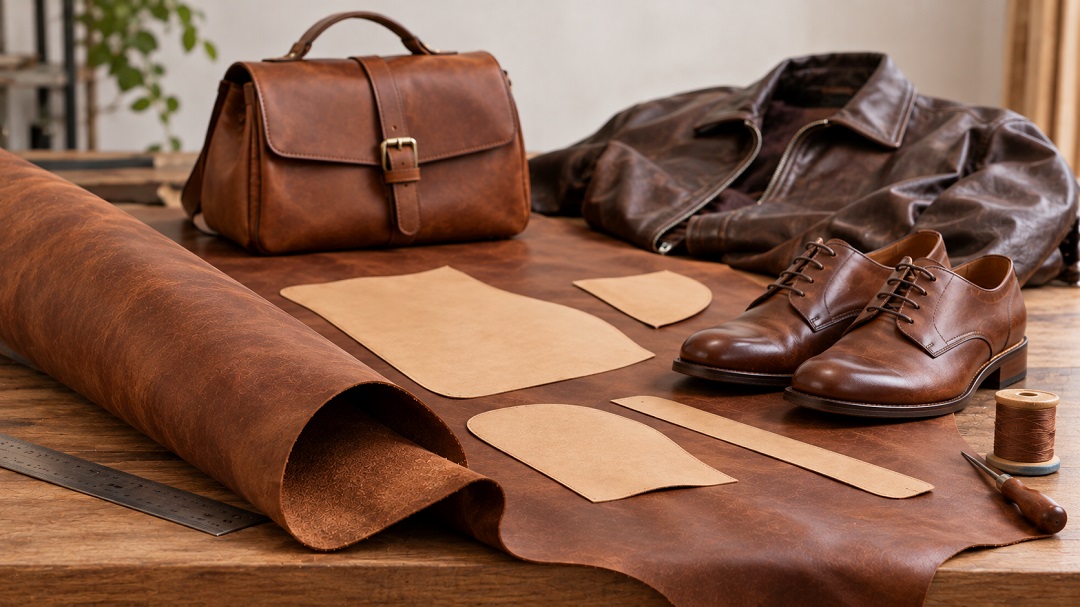
Before starting a leathercraft project, one important question needs to be answered: how much leather should I buy? The answer depends on more than the finished size of the item. It also depends on the pattern, the number of individual pieces, their dimensions and how efficiently the leather surface can be used.
The requirements vary considerably between making a bag, a leather jacket and a pair of shoes. Each project involves different components, cutting requirements and material specifications. Calculating the quantity correctly helps you choose the right amount of leather, avoiding unnecessary purchases or running out of material halfway through the project.
Where Should You Start?
The first step is to have the pattern for your project. Without it, any estimate is largely guesswork.
List every piece that needs to be cut from leather and record its dimensions. Depending on the project, these may include the outer panels of a bag, the front and back sections of a jacket, sleeves or the individual components of a shoe upper.
When calculating the required area, include the actual cutting dimensions, together with seam allowances, folded edges and any other details required by the pattern. Knowing only the finished dimensions of the item is not enough.
How Do You Calculate the Required Leather Area?
For each rectangular piece, multiply its length by its width to calculate its area. Then add the areas of all the individual components.
Here is a simple example for a bag:
- 2 main panels, measuring 30 × 40 cm: 2,400 cm²
- 2 side panels, measuring 10 × 40 cm: 800 cm²
- 1 base, measuring 30 × 10 cm: 300 cm²
- 4 inner pockets, measuring 15 × 10 cm: 600 cm²
The total area of these pieces is 4,100 cm², or 0.41 m².
This is the net area of the pattern pieces in our example. It does not mean that buying exactly 0.41 m² of leather will be sufficient. In practice, you also need to account for the space lost when arranging and cutting the patterns.
For curved or irregularly shaped pieces, multiplying length by width provides only a rough estimate. A more reliable approach is to arrange the actual patterns on a surface and calculate the total area they occupy.
How Much Leather Do You Need for a Bag?
The amount of leather required for a bag depends on its size, design and construction. A small bag with a few outer sections has different requirements from a large bag with side panels, a reinforced base, inner pockets and long straps.
Your calculation should include every individual component: front and back panels, sides, base, straps, handles and any external pockets. If the design includes a separate lining or different materials for the interior, those quantities should be calculated separately.
Extra attention is needed when large outer panels must have a similar texture or appearance. In this case, having enough total surface area is not sufficient. You also need suitable continuous sections of leather for cutting those panels.
How Much Leather Do You Need for a Leather Garment?
For leather garments such as jackets, trousers and vests, the calculation is based on the pattern and the size of the garment.
A leather jacket, for example, may consist of front and back panels, sleeves, a collar, pockets, a belt and other details. Each component needs to be included in the calculation.
The arrangement of the pieces on the leather also matters. Large garment panels require sufficiently sized areas, while sleeves and smaller components should be positioned in a way that makes the best possible use of the available material.
If you want both sleeves or other symmetrical parts to have a similar appearance, you should also consider consistency in colour and texture. This can limit the available cutting options and increase the amount of leather required.
How Much Leather Do You Need for a Pair of Shoes?
Shoemaking has its own specific requirements. A shoe upper consists of individual components, such as the vamp, quarters, heel sections and tongue, depending on the design.
To calculate the required amount, you need to know the pattern, the shoe size and the number of pairs you intend to make. You should also consider that the right and left shoes need corresponding pieces with a suitable and consistent appearance.
In this case, total surface area is not the only factor. The position of the patterns on the leather, the direction of the surface, natural marks and the ability to cut matching pieces for both shoes all affect material usage.
It is also important to distinguish the leather needed for the upper from the other materials used in shoemaking, such as lining, reinforcements and sole materials.
Why Should You Allow for Extra Leather?
Natural leather does not have the uniform, rectangular shape of a sheet of paper or fabric. Each hide has an irregular outline and may contain natural marks, variations in texture or areas that are not suitable for every part of a project.
Patterns also cannot always be placed directly next to one another without leaving gaps. Curves, corners and pieces of different sizes create offcuts that may not be suitable for another component.
For this reason, the total area stated for a hide does not necessarily represent the amount you can use for a particular project. The usable area depends on the shape of the hide, its surface characteristics and the requirements of the finished item.
How Much Extra Leather Should You Allow?
There is no single percentage that works for every project. A bag with large panels, a jacket with multiple components and a pair of shoes all have different material requirements.
The safest approach is to arrange the patterns first and estimate the offcuts that will be left after cutting. If you have limited cutting experience, it makes sense to allow a larger margin for practice and possible mistakes.
Once you have an established pattern and understand how a particular type of leather can be used, your estimates can become more accurate. In every case, it is better to calculate the required quantity based on the actual arrangement of the pieces rather than simply adding up their individual areas.
How Does Leather Selection Affect the Calculation?
The pattern is not the only factor that matters. The type of leather also plays an important role. Thickness, texture, finish and available surface area can all influence how the material is cut and used.
For example, a project requiring large, uniform outer panels needs suitable, clean areas of leather. By contrast, a project made up of many smaller pieces may offer more flexibility, allowing you to use different sections of the hide.
Before purchasing, it is useful to have all your pattern measurements ready, know the thickness required for the project and identify which areas of the leather are suitable for each component.
Accurate Leather Planning Starts with the Pattern
To calculate how much leather you need for a bag, garment or pair of shoes, you should look beyond the finished dimensions of the item. List every individual pattern piece, include the necessary cutting and seam allowances, and account for the material lost when arranging the patterns.
This approach helps you choose the right amount of leather, reduce unnecessary offcuts and organise your project more effectively before cutting begins.
Frequently Asked Questions
How is leather measured?
Leather area is commonly measured in square metres (m²), square decimetres (dm²) or square feet (sq ft), depending on the supplier. One square metre equals 100 square decimetres.
Should seam allowances be included in the pattern calculation?
Yes. Use the actual cutting dimensions of each pattern piece, including any allowances required for stitching, folding or other construction details.
Can leather offcuts be reused?
Absolutely. Smaller offcuts can be used for pouches, small accessories, labels or decorative details, provided their size and condition are suitable.
Is the total leather area the same as the usable area?
Not necessarily. The irregular shape of a hide, natural surface marks and the arrangement of the patterns all affect how much leather can be used for a specific project.